



If you’ve spent any time on a busy lake lately, you’ve probably noticed something that doesn’t make sense on paper: a so-called “250-horsepower” Yamaha hanging right there with a “325-horsepower” Sea-Doo or Kawasaki in a straight-line run. Riders keep asking us the same thing: how is that even possible?
We did the research to find out so you don’t have to—and the answer matters if you’re shopping, tuning, or just defending your pride at the sandbar.
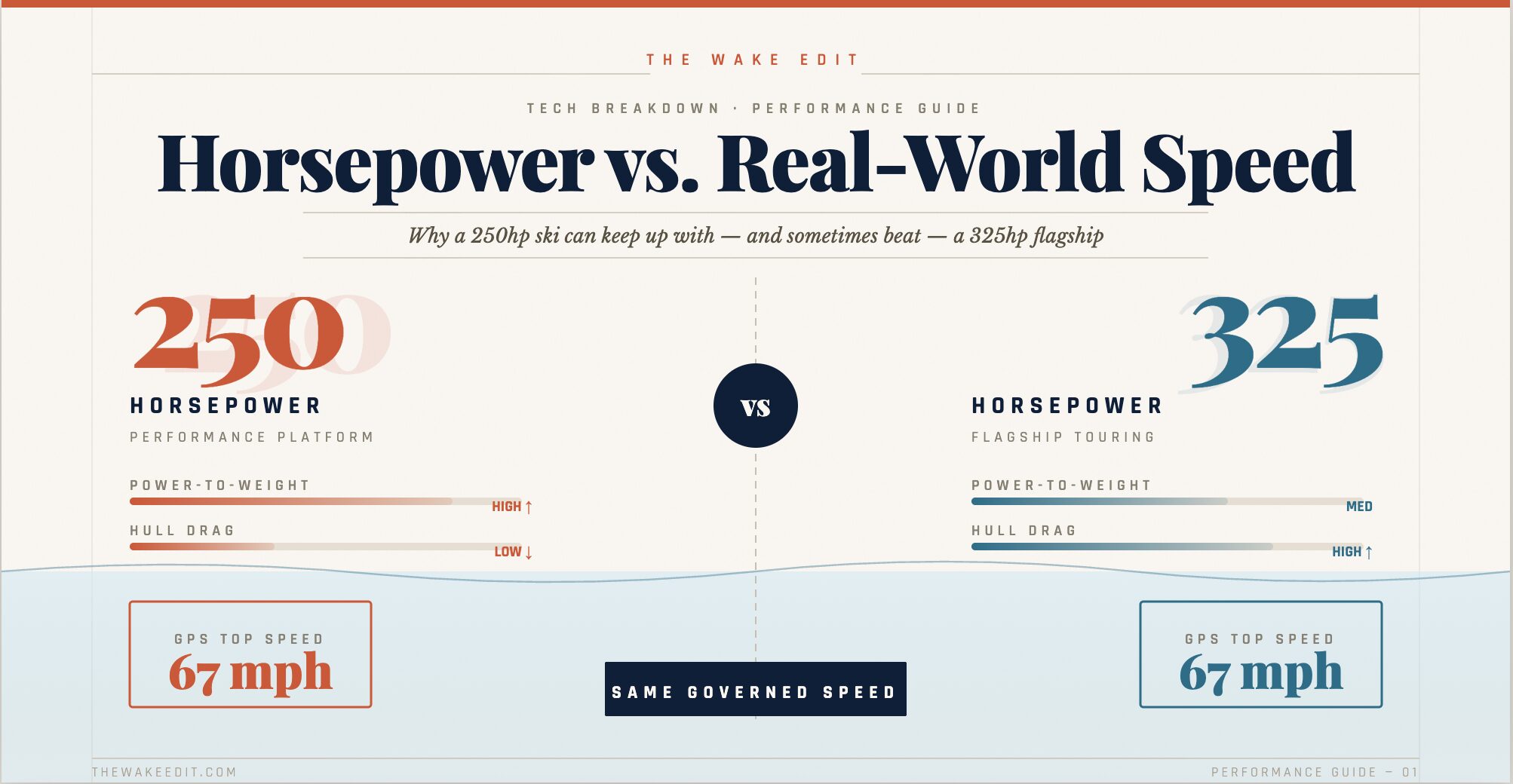
Horsepower sells PWCs, but it doesn’t automatically decide who wins the drag race. In the real world, a 250-horsepower PWC can keep up with, or even beat, a 325-horsepower ski because speed and acceleration depend on more than a single number on a spec sheet. Factors like power-to-weight ratio, hull design, pump efficiency, impeller pitch, electronic speed limiters, rider weight, and even launch technique all help determine how fast a craft actually moves across the water.
On land, more power usually means more speed. On water, that relationship is filtered through hull drag and how efficiently the jet pump converts engine power into thrust. That is why two skis with very different horsepower ratings can run nearly identical speeds on GPS.
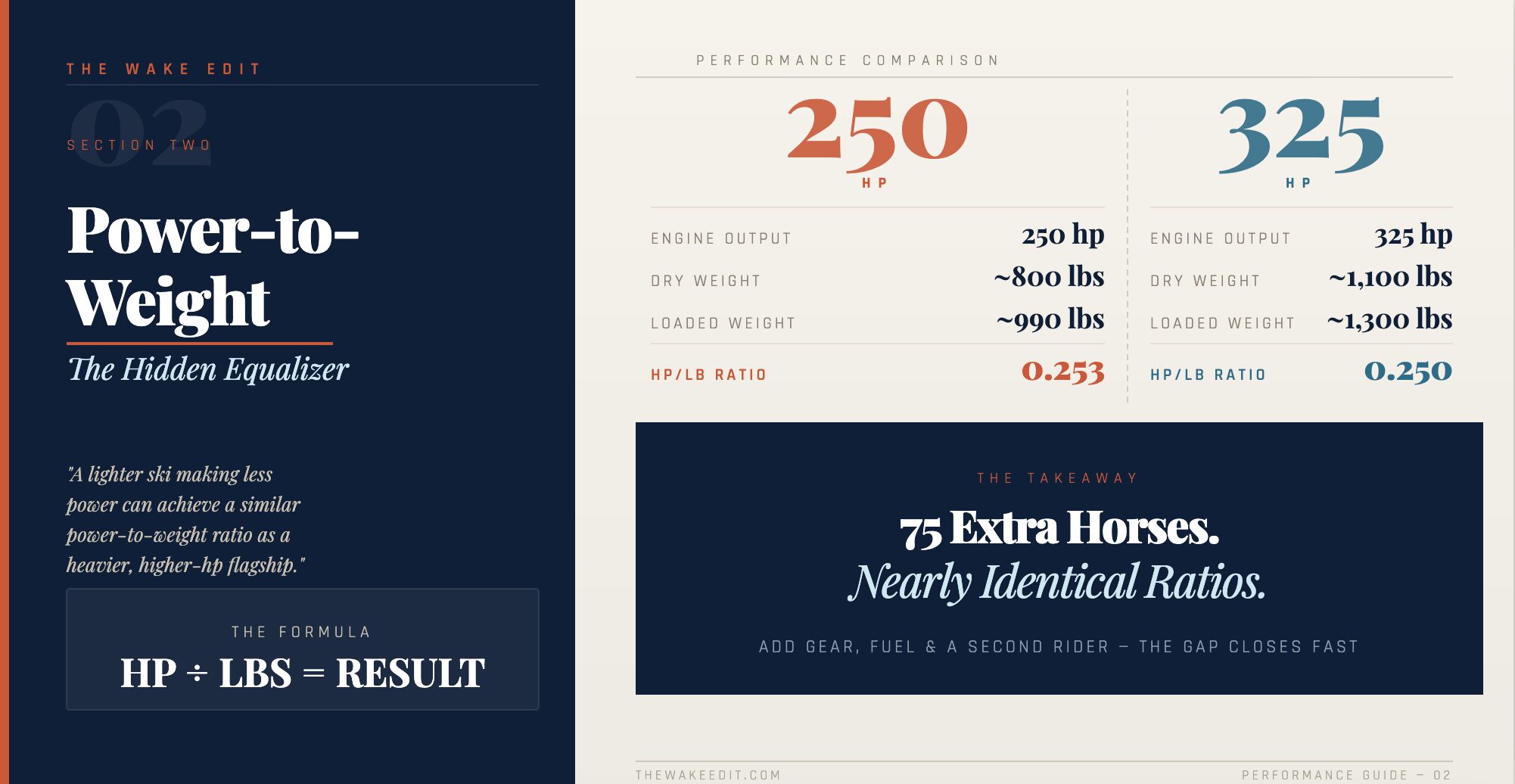
If you want to understand why a 250 can hang with a 325, start with power-to-weight ratio. A lighter PWC that makes less power can still achieve a very similar—or sometimes better—power-to-weight ratio than a heavier, more feature-loaded flagship ski with a bigger engine. Once you factor in fuel, gear, and a second rider, the “big” ski may have to work much harder just to move its mass.
Every extra pound adds drag in the water, especially during acceleration. A leaner 250-horsepower performance platform can launch harder and feel more responsive than a heavier 325 set up for luxury or touring. That’s why you’ll often see smaller-number skis staying right in the fight in short lake-length runs.
Hull design is the other big reason the spec sheet lies. A performance-oriented hull rides higher, keeps less wetted surface in the water, and cuts through chop more efficiently. That reduces hydrodynamic drag, which means it takes less horsepower to hit a given speed.
By contrast, many 300-plus-horsepower models are built on larger, more comfortable hulls with more storage, thicker seats, and features designed for stability and long-distance comfort. They excel in rough water and with passengers on board, but they push more water and create more drag. Put that hull against a smaller, sharper, lightweight 250-horsepower ski in smooth water and the drag penalty can erase much of the power advantage.
Drag also increases dramatically at higher speeds. Each additional mile per hour takes more and more power to achieve. A “slippery” hull lets a lower-horsepower engine break into top-speed territory that looks impossible if all you’ve looked at is the brochure.
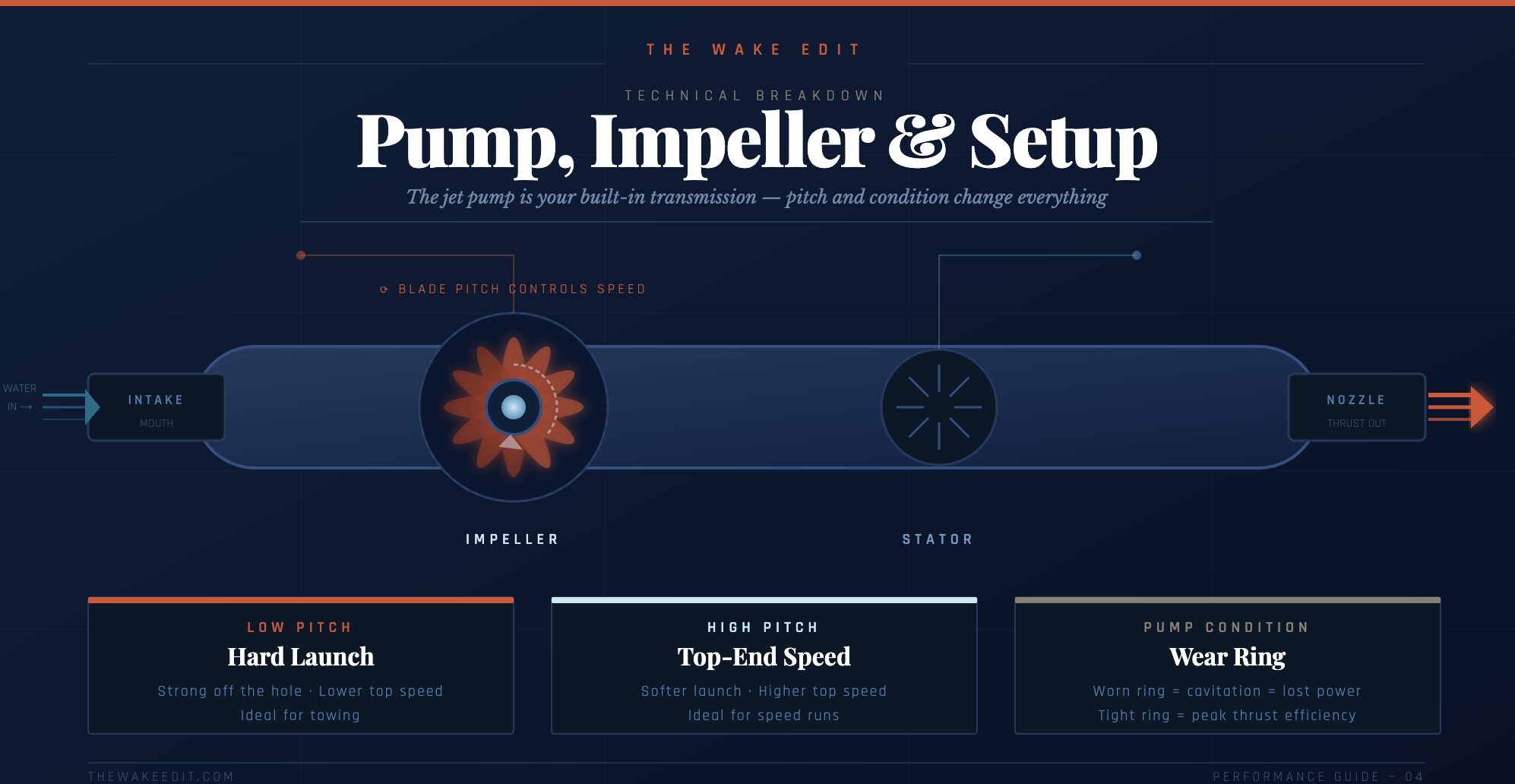
Because PWCs are jet-propelled, the pump and impeller behave like a built-in transmission. Change the impeller pitch or condition and you change the ski’s personality. A lower-pitch impeller lets a high-horsepower ski rocket out of the hole and tow strongly, but it will often sacrifice top speed. A higher-pitch impeller on a 250 might feel softer at launch, yet it can carry more speed once the ski is fully hooked up and running clean water.
Pump condition matters just as much. A tight, healthy pump and wear ring on a 250 can be more efficient than a slightly worn or cavitating pump on a 325. You never see that difference on paper, but you absolutely see it when you line up for a drag race.
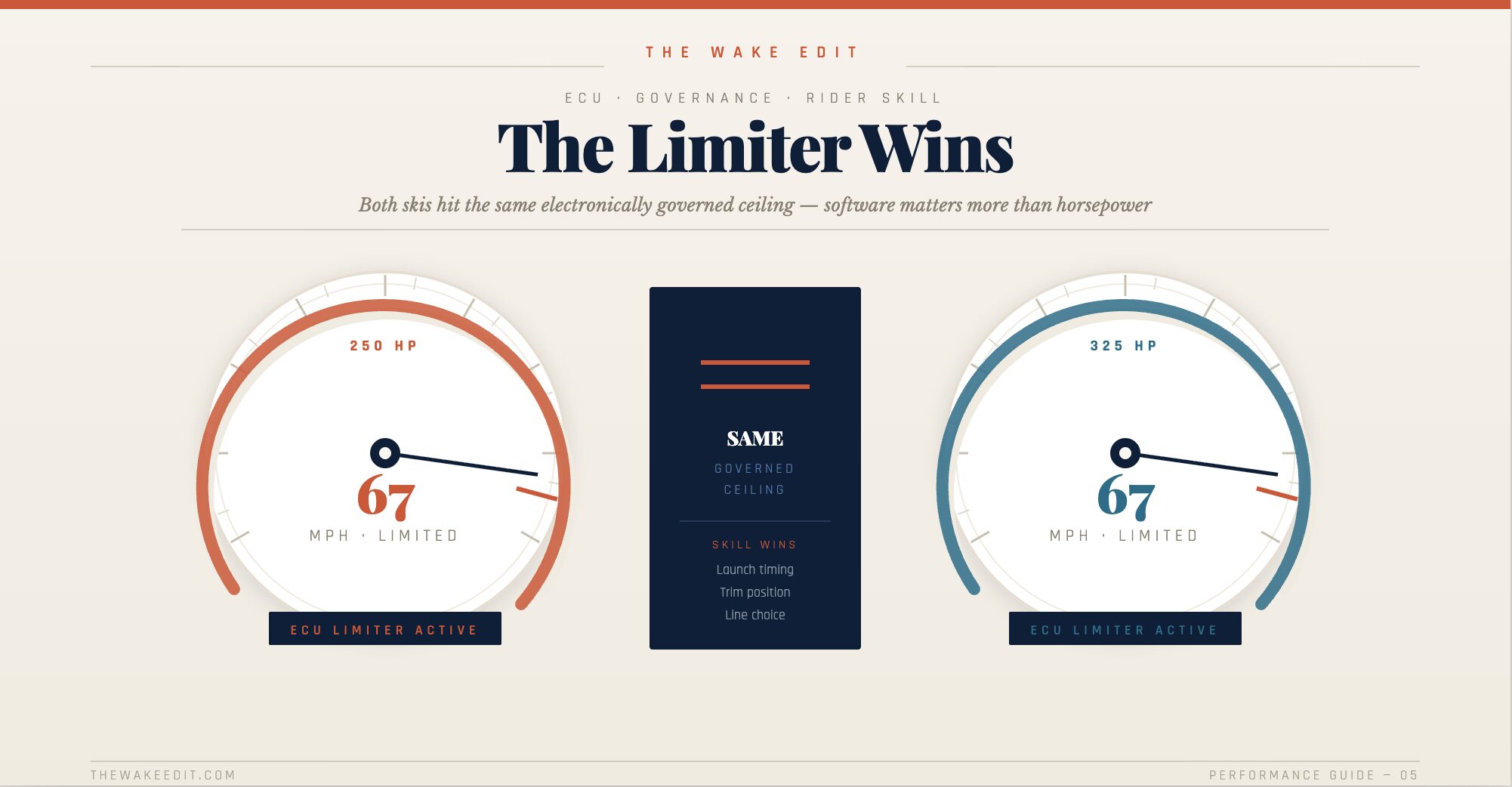
Here’s the part almost nobody mentions at the dock: many modern performance PWCs are electronically limited to similar top speeds for safety, regulations, and liability reasons. In practice, that means a 250-horsepower and a 325-horsepower flagship can both hit the same governed ceiling in stock form. The bigger engine gets you there faster, but once the limiter kicks in, both skis are effectively capped at roughly the same speed.
That’s why owners of “less powerful” skis keep coming back saying, “I thought that thing had 75 more horsepower—why didn’t it walk away from me?” The answer is that, at the top end, software is often more important than raw horsepower.
Once you add in ECU tunes, impeller swaps, and other modifications, the picture gets even more interesting. A carefully tuned 250 platform optimized for one rider and one set of conditions can be shockingly fast. Rider skill, launch timing, trim position, line choice over chop, can easily decide a close race between mismatched horsepower numbers.
What This Means for Riders and Buyers
For riders, the takeaway is simple: horsepower is a headline, not a verdict. A 250-horsepower WaveRunner can keep up with a 325-horsepower jet ski because of power-to-weight balance, hull efficiency, jet pump setup, and software limits—not because physics stopped working. For buyers, that means you should look past the biggest number on the page and pay attention to weight, hull type, intended use, and top-speed limiters.
If you want to win your next dock-side argument, remember this: “more horsepower” is only an advantage if the rest of the package lets you use it.
Frequently Asked Questions:
- Does higher horsepower always mean a faster jet ski? No. Higher horsepower gives a ski more potential, but real-world speed depends on weight, hull design, pump efficiency, and any electronic speed limiters built into the craft.
- How can a 250-horsepower PWC keep up with a 325-horsepower ski? A lighter 250-horsepower ski with an efficient hull and well-matched impeller can have a comparable power-to-weight ratio and lower drag, allowing it to run similar speeds in many conditions.
- Why are many high-horsepower jet skis limited in top speed? Manufacturers often cap top speed electronically to meet safety, regulatory, and liability requirements, which can cause different-horsepower models to cluster around the same maximum speed.
- What matters more for acceleration: horsepower or setup? Both matter, but setup is critical. Impeller pitch, pump health, hull design, and rider weight can dramatically change how quickly a ski jumps on plane and reaches its limiter.
- What should I look at besides horsepower when buying a jet ski?Consider weight, hull design, intended use (performance, touring, towing), fuel capacity, electronic speed limits, and how the craft feels with your typical load and riding conditions, not just the horsepower rating.